


Jabiru
Supporting safe operations
For over 35 years, Jabiru has designed its products within the framework of constantly evolving ultralight and recreational aviation standards and regulations. The company has held type and production certificates in Australia as well as in other countries. Today, Jabiru primarily positions its products in the Light Sport Aircraft (LSA) and Experimental Aircraft (EA) categories, relying on ASTM standards for design, quality, and continued airworthiness.
For the vast majority of its current products and operations, Jabiru acts as a self-certifying OEM, under the regulations applicable to the LSA and Experimental categories.
To guide its safety efforts, Jabiru relies heavily on feedback from its owners, maintainers, and pilots, as well as on information gathered from administrative and regulatory authorities. This approach ensures that safety decisions remain grounded in real-world operational experience. Every two years, Jabiru conducts a safety review of its Australian fleet based on data provided notably by CASA, the ATSB, BITRE, and RAAus.
By comparing the observed results with those of the rest of the fleet, Jabiru can assess its safety performance and adjust its action priorities accordingly.
This analysis draws on millions of flight hours accumulated by the Jabiru fleet, providing a solid statistical foundation.
To ensure ongoing support for the fleet, regardless of its operating category, Jabiru is committed to publishing its service documentation in line with the ASTM F3198 standard, in order to help maintain the continued safety of the in-service fleet according to an industry-recognized framework. It is essential that aircraft and engine owners keep their contact details up to date with Jabiru so they can promptly receive any new service documentation or updates.
The data presented in the latest safety review covers the period up to the end of 2022. Event data comes from the ATSB, while usage data was provided by BITRE and RAAus. The results are compared against the RAAus fleets, the Australian general recreational aviation fleet, and the FAA recreational fleet. For both Australian fleets, Jabiru products are excluded from the comparison, so that the analysis focuses on the rest of the fleet.

engine
Operation Bulletproof
While Jabiru aircraft have earned a strong reputation for ruggedness and durability, the company acknowledges that its engines have not always consistently met that same standard.
Today’s GEN4 engines deliver a best-in-class power-to-weight-to-cost ratio, thanks to an approach built on controlled simplicity. But Jabiru is aiming even higher: it’s not just about meeting industry standards. Pilots now expect immediate, uncompromising reliability, with engines that start on demand and deliver consistent performance flight after flight. Operation Bulletproof embodies this commitment.
This initiative goes beyond simply improving engine design. It spans Jabiru’s entire safety model, with several key areas of focus:
- enhanced sharing of technical knowledge, through more robust distribution systems;
- a redesign of service documentation, with revised bulletins and manuals that are more frequent and clearer;
- the Jabiru Approved Maintainers program, aimed at harmonizing maintenance standards worldwide;
- expanded training for owners and maintainers;
- stricter requirements for supplier quality;
- and strengthened quality processes throughout manufacturing.
Safety Data
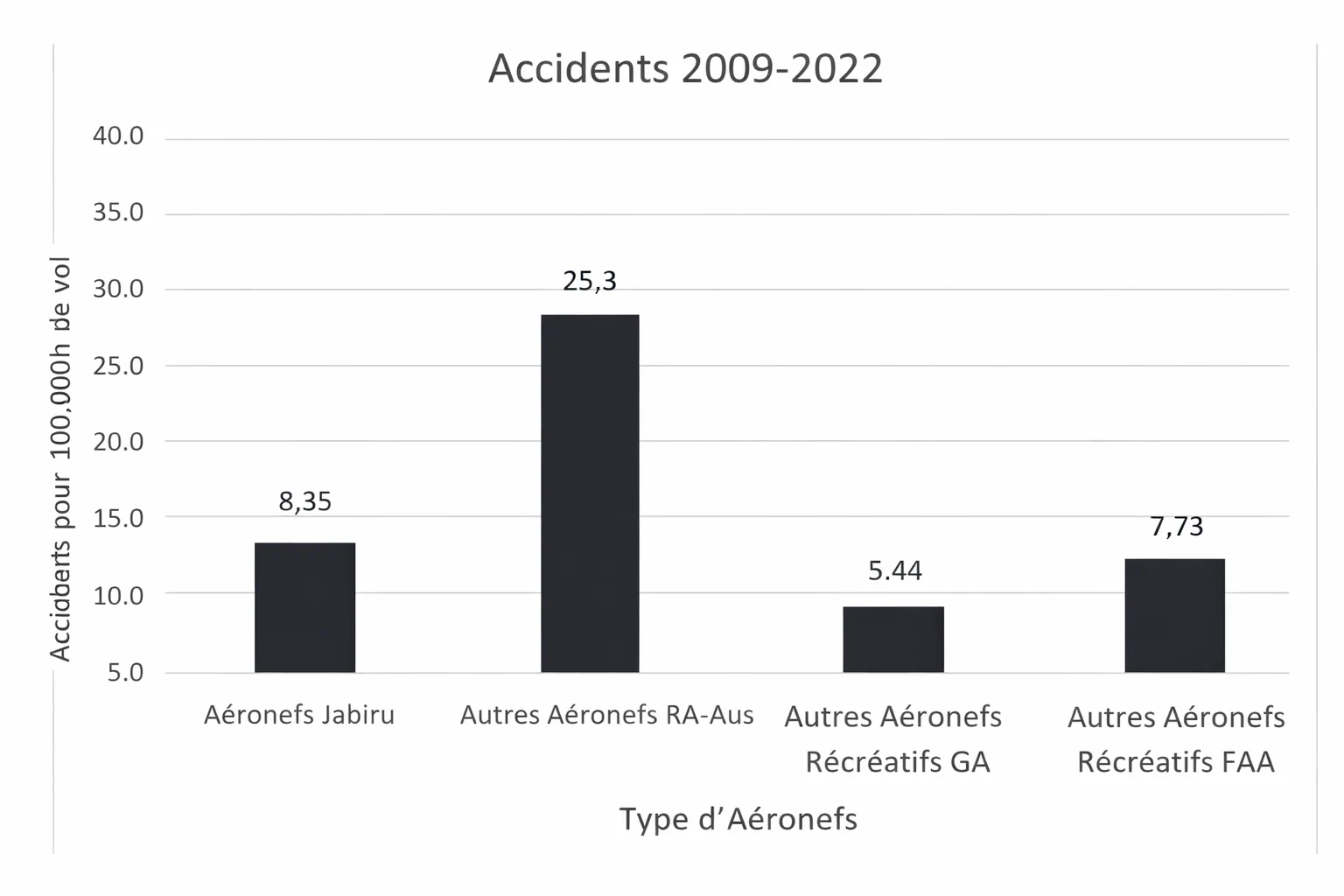
The data from the latest safety review covers approximately a decade of operations, during which the Jabiru fleet in Australia accumulated roughly one million flight hours. This represents a statistically significant sample. The methodology used to collect the data and classify events is identical to that of the ATSB, ensuring a fair and valid basis for analysis. Events are normalized per flight hour to allow for consistent comparisons.

The results for the Jabiru fleet are compared with those of the fleet registered with Recreational Aviation Australia, the Australian general recreational aviation fleet, and the recreational fleet of the Federal Aviation Administration. Again, for both Australian fleets, Jabiru products are excluded from the comparison in order to measure Jabiru’s performance against the rest of the fleet.

Jabiru Engines
Jabiru-powered aircraft show an engine incident rate per 100,000 flight hours that is broadly comparable to that of other RA-Aus registered powered aircraft. This assessment is based on a rigorous monitoring approach, grounded in the analysis of operational data and its comparison with industry-wide figures. At Jabiru, these results directly inform the ongoing improvement of engine design, maintenance standards, service documentation, and operational support.

